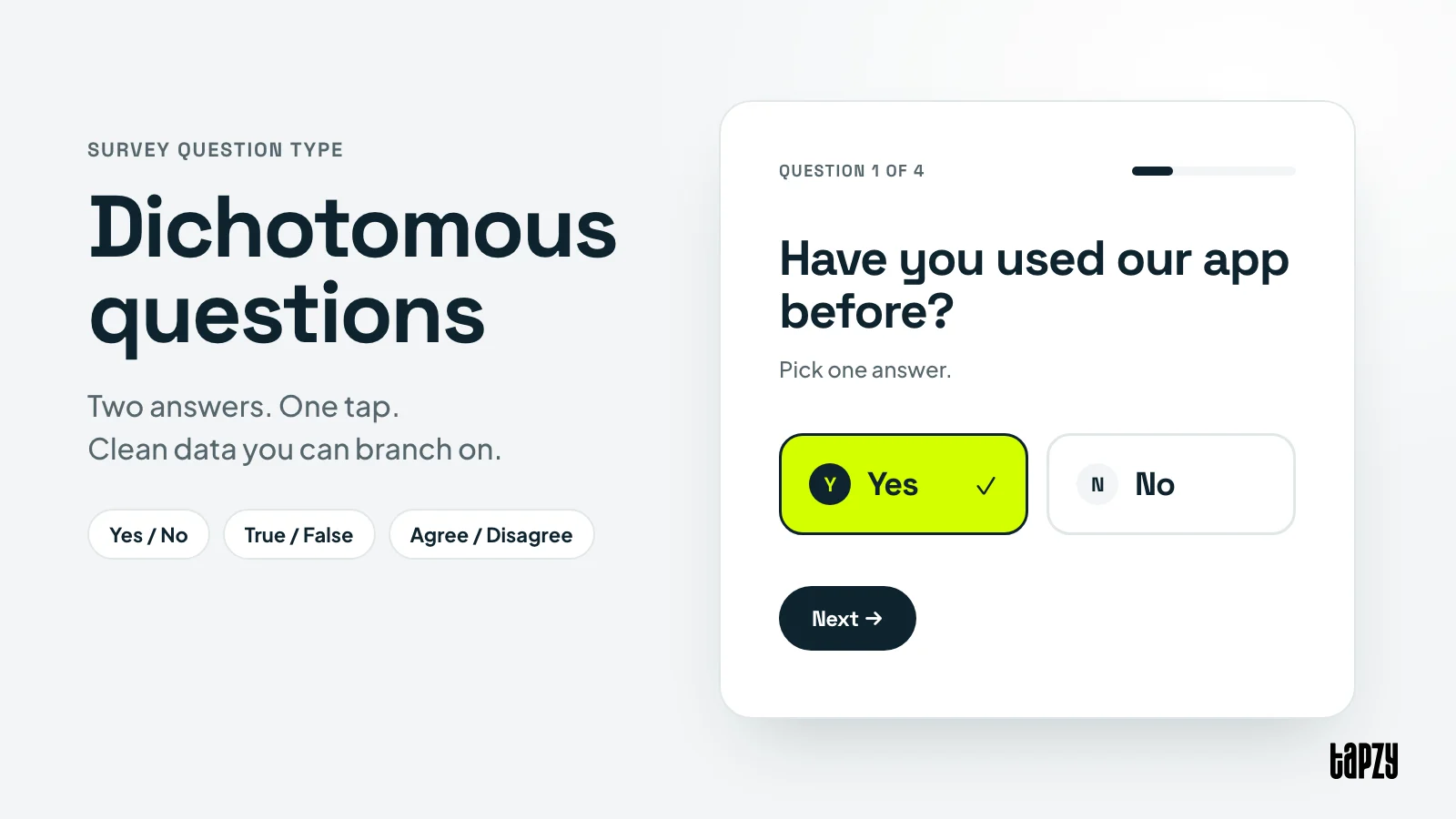
Dichotomous questions are the simplest questions you can put in a survey: each one has only two possible answers. You have almost certainly answered one today, for example “Have you used our app before?” Yes / No.
They look basic, but they do a lot of work. They filter respondents, power skip logic and give you data that is easy to count. In this guide you will learn what a dichotomous question is, the six main types, 42 examples grouped by use case, the pros and cons, and how to write good ones.
What are dichotomous questions?
A dichotomous question is a closed-ended survey question with exactly two answer options, such as Yes/No, True/False or Agree/Disagree. The two options are opposites, so each respondent must pick one. Researchers use them to collect clear, fact-based answers that are fast to give and easy to analyze.
The word “dichotomous” comes from the Greek dichotomia, meaning “a cutting in two.” A dichotomy splits something into two separate parts, and that is exactly what these questions do with your audience. You will also see them called binary questions or yes or no survey questions.
Types of dichotomous questions
The answer pair changes the meaning. Here are the six most common types.
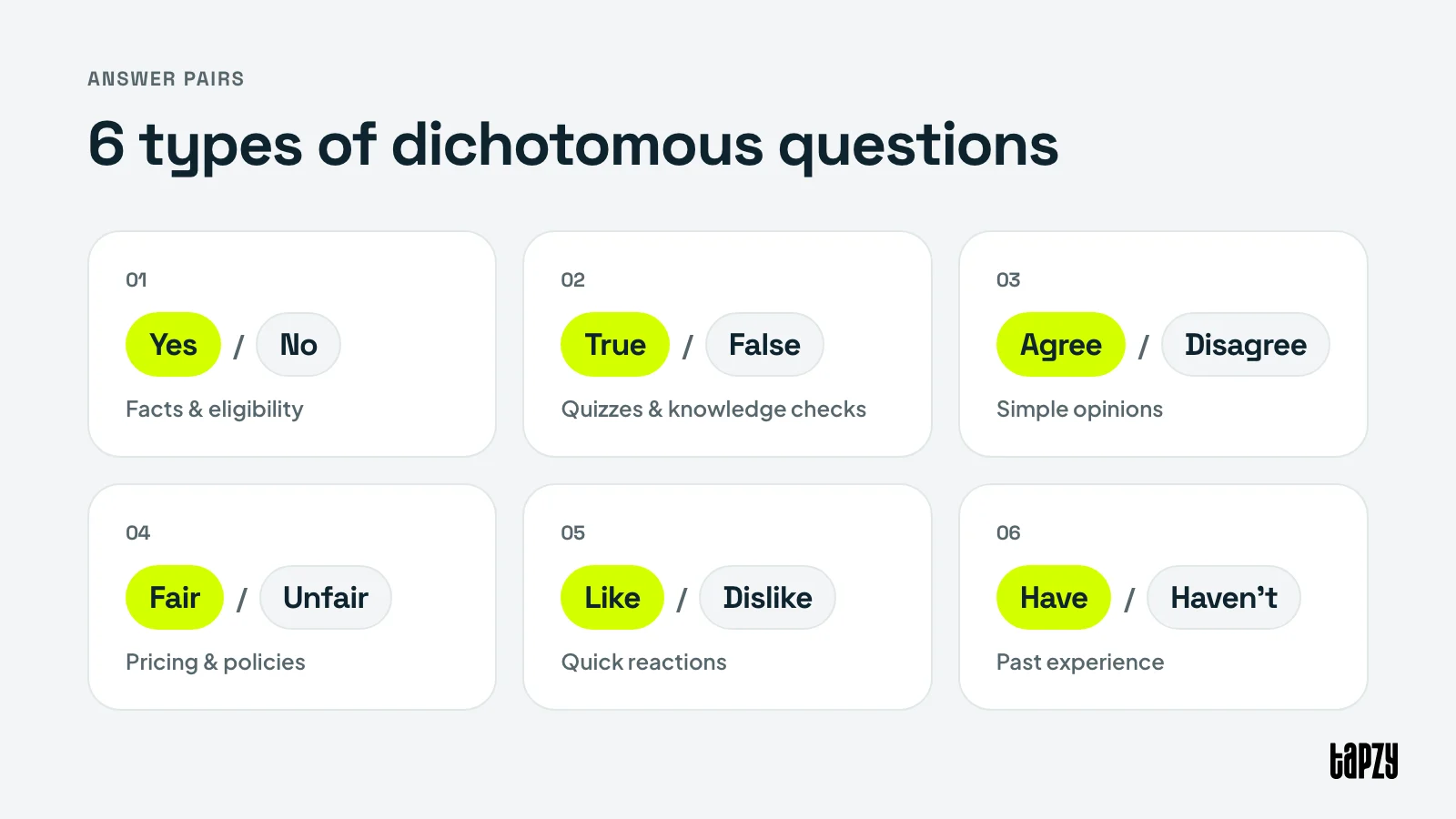
Yes / No
The most common type. Use it for facts, behavior and eligibility.
- Do you currently own a car?
- Did you receive your order on time?
True / False
Best for knowledge checks, quizzes and policy acknowledgments.
- The Earth orbits the Sun once every 365.25 days.
- Employees must complete safety training every year.
Agree / Disagree
Captures a simple position on a statement. (A Likert scale adds levels in between.)
- The checkout process was easy to follow.
- Remote work should be an option for all staff.
Fair / Unfair
Useful for questions about pricing, policies and decisions.
- Do you think our new subscription price is fair or unfair?
- Was the performance review process fair or unfair?
Like / Dislike
Quick reactions to a design, feature or piece of content.
- Do you like or dislike the new homepage design?
- Did you like or dislike this episode?
Have / Haven't
Good for past experience and screening.
- Have you or haven't you attended one of our webinars?
- Have you or haven't you traveled abroad in the past 12 months?
42 dichotomous question examples (by use case)
Copy and adapt these dichotomous question examples for your own forms. Each set shows the Tapzy field to build it with.
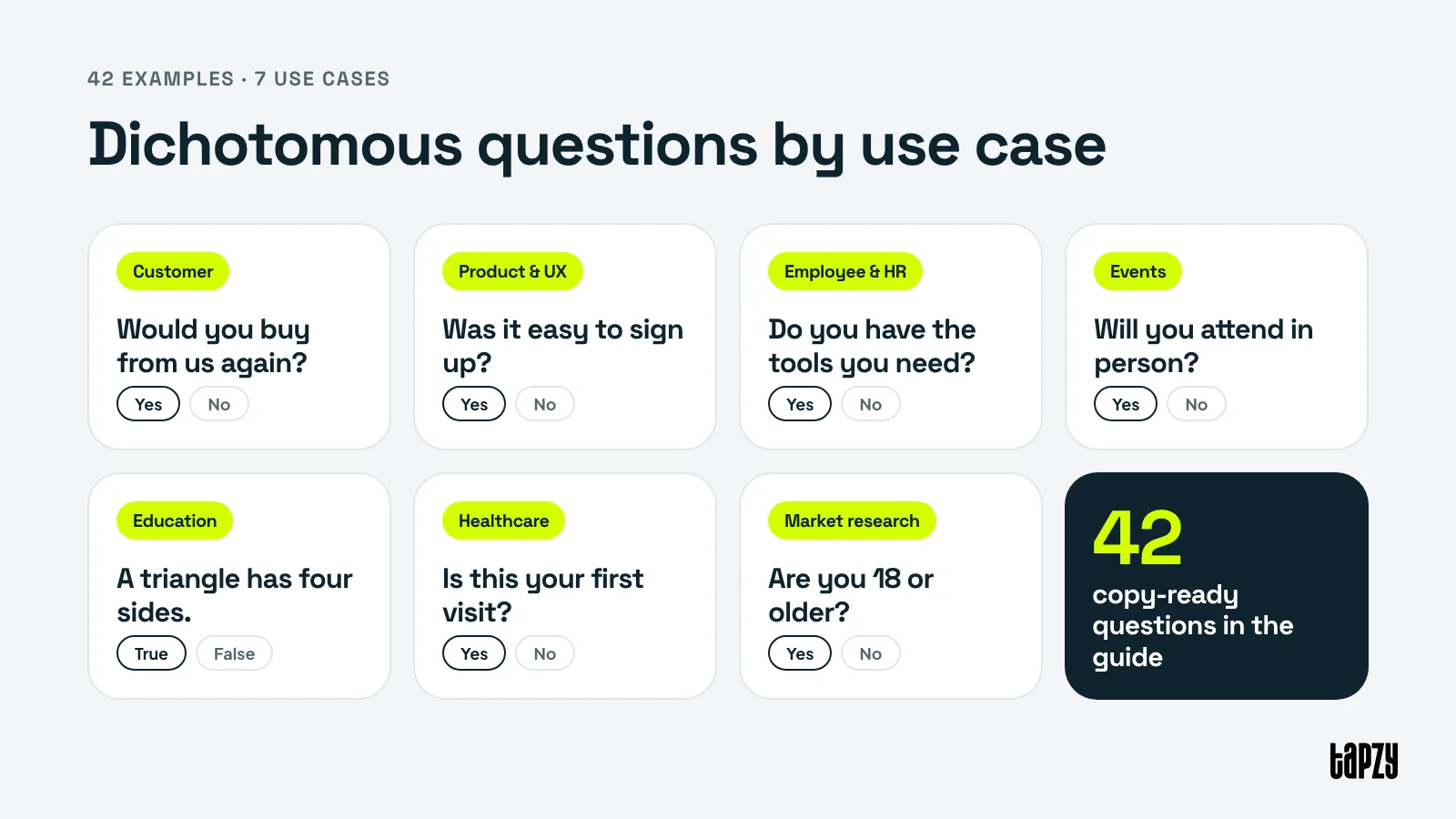
Customer satisfaction
- 1.Did our product meet your expectations?Yes / No
- 2.Was your issue resolved on the first contact?Yes / No
- 3.Would you buy from us again?Yes / No
- 4.Did you find what you were looking for today?Yes / No
- 5.Was our support team polite and helpful?Yes / No
- 6.Would you recommend us to a friend?Yes / No
Need more ideas? See these feedback form samples.
Product and UX research
- 1.Have you used the new dashboard feature?Yes / No
- 2.Was it easy to sign up for an account?Yes / No
- 3.Did you complete the onboarding tour?Yes / No
- 4.Do you use our app on a mobile device?Yes / No
- 5.Did you run into any errors today?Yes / No
- 6.Would you pay for a premium version of this feature?Yes / No
Employee and HR surveys
- 1.Do you have the tools you need to do your job well?Yes / No
- 2.Do you understand how your work supports company goals?Yes / No
- 3.Have you had a one-on-one with your manager this month?Yes / No
- 4.Do you feel safe sharing ideas in team meetings?Yes / No
- 5.Are you aware of our mental health benefits?Yes / No
- 6.Do you see yourself working here in two years?Yes / No
Event registration and feedback
- 1.Will you attend the event in person?Yes / No
- 2.Do you have any dietary restrictions?Yes / No
- 3.Do you need accessibility support at the venue?Yes / No
- 4.Is this your first time attending this event?Yes / No
- 5.Did the sessions match the event description?Yes / No
- 6.Would you attend this event again next year?Yes / No
Education and quizzes
- 1.Water boils at 100°C at sea level.Yes / No (labels: True / False)
- 2.Did you complete the assigned reading before class?Yes / No
- 3.Was the lesson pace comfortable for you?Yes / No
- 4.A triangle has four sides.Yes / No (labels: True / False)
- 5.Do you have reliable internet access at home?Yes / No
- 6.Would you like extra practice material on this topic?Yes / No
Building a test? Here is how to make a multiple choice quiz online.
Healthcare and patient intake
- 1.Is this your first visit to our clinic?Yes / No
- 2.Do you have any known allergies to medication?Yes / No
- 3.Are you currently taking any prescription medicines?Yes / No
- 4.Do you smoke or use tobacco products?Yes / No
- 5.Have you had surgery in the past 12 months?Yes / No
- 6.May we contact you by text message about appointments?Yes / No
Market research and screening questions
- 1.Are you 18 years of age or older?Yes / No
- 2.Are you responsible for purchasing decisions at your company?Yes / No
- 3.Have you bought running shoes in the past six months?Yes / No
- 4.Do you work in marketing, advertising or market research?Yes / No
- 5.Do you currently use a project management tool?Yes / No
- 6.Would you be willing to join a 30-minute follow-up interview?Yes / No
When to use dichotomous questions
Dichotomous survey questions work best when the real answer has only two sides. Use them for:
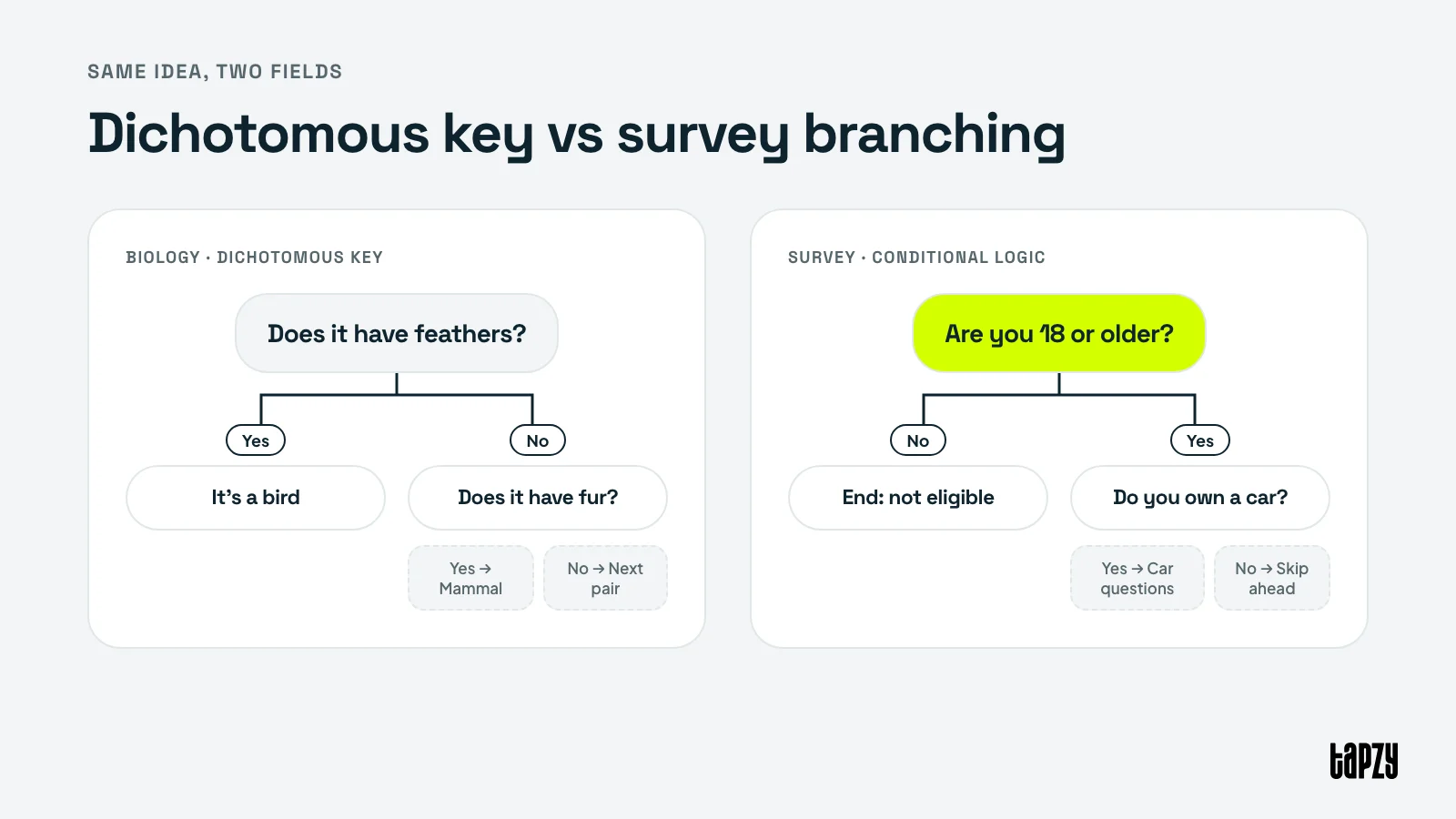
- Screening and qualifying respondents. Remove people who do not fit your target group before they answer the full survey (for example, “Are you 18 or older?”).
- Branching with conditional logic. A “Yes” can open a follow-up section, while a “No” skips it.
- Quick polls. One question, one tap. Great for websites, emails and live events.
- Eligibility checks. Grants, offers, appointments and signups often depend on simple yes/no conditions.
- Fact-based answers. Things like “Did you receive the email?” have a clear right answer.
If the honest answer is “it depends” or “somewhat,” choose a different question type.
Pros and cons of dichotomous questions
| Pros | Cons |
|---|---|
| Quick to answer: one tap, little thinking needed. | No nuance: no room for “a little” or “sometimes.” |
| Easy to analyze: results show as simple percentages. | Forced choice: people in the middle must pick a side. |
| Higher completion: short, easy questions reduce effort and drop-off. | Possible bias: wording and answer order can push people toward one answer. |
| Good for logic branching: two clean paths make skip logic simple. | No “why”: you learn what people think, not the reason behind it. |
The fix for most cons is simple: pair your dichotomous questions with an open-ended follow-up where the reason matters.
Dichotomous vs other question types
| Question type | What it is | Best use | Example |
|---|---|---|---|
| Dichotomous | Two opposite answer options | Screening, facts, branching | “Have you used our app before?” Yes / No |
| Multiple choice | Three or more fixed options | Preferences, categories | “Which plan are you on?” Free / Pro / Team |
| Likert scale | Levels of agreement, usually 5 or 7 points | Attitudes and opinions | “The app is easy to use.” Strongly disagree → Strongly agree |
| Rating scale | A score on a numeric or star scale | Satisfaction, quality | “Rate your support experience from 1 to 5.” |
| Open-ended | Free-text answer | Reasons, ideas, stories | “What could we improve?” |
All of these except open-ended are closed-ended questions. Dichotomous questions are simply the most restricted kind of closed-ended question.
Best practices for writing dichotomous questions
1. Make the options mutually exclusive
Each person should fit only one answer. If both answers could be true, rewrite the question.
2. Avoid leading wording
“Don’t you agree our new design is much better?”
“Do you prefer the new design to the old one?”
Pew Research Center's guide to writing survey questions explains how wording and question order can change results.
3. Ask one thing per question
“Was our staff friendly and fast?”
“Was our staff friendly?” then “Was our service fast?”
This is called a double-barreled question. A “No” to the first version could mean unfriendly, slow or both, so you cannot act on it.
4. Add “Not sure” only when you need it
A third option like “Not sure” or “Prefer not to say” makes the question no longer strictly dichotomous. That is fine when people truly may not know. Leave it out for clear facts, or many people will take the easy way out.
5. Follow up with an open-ended “why”
“Would you recommend us?” and the survey ends.
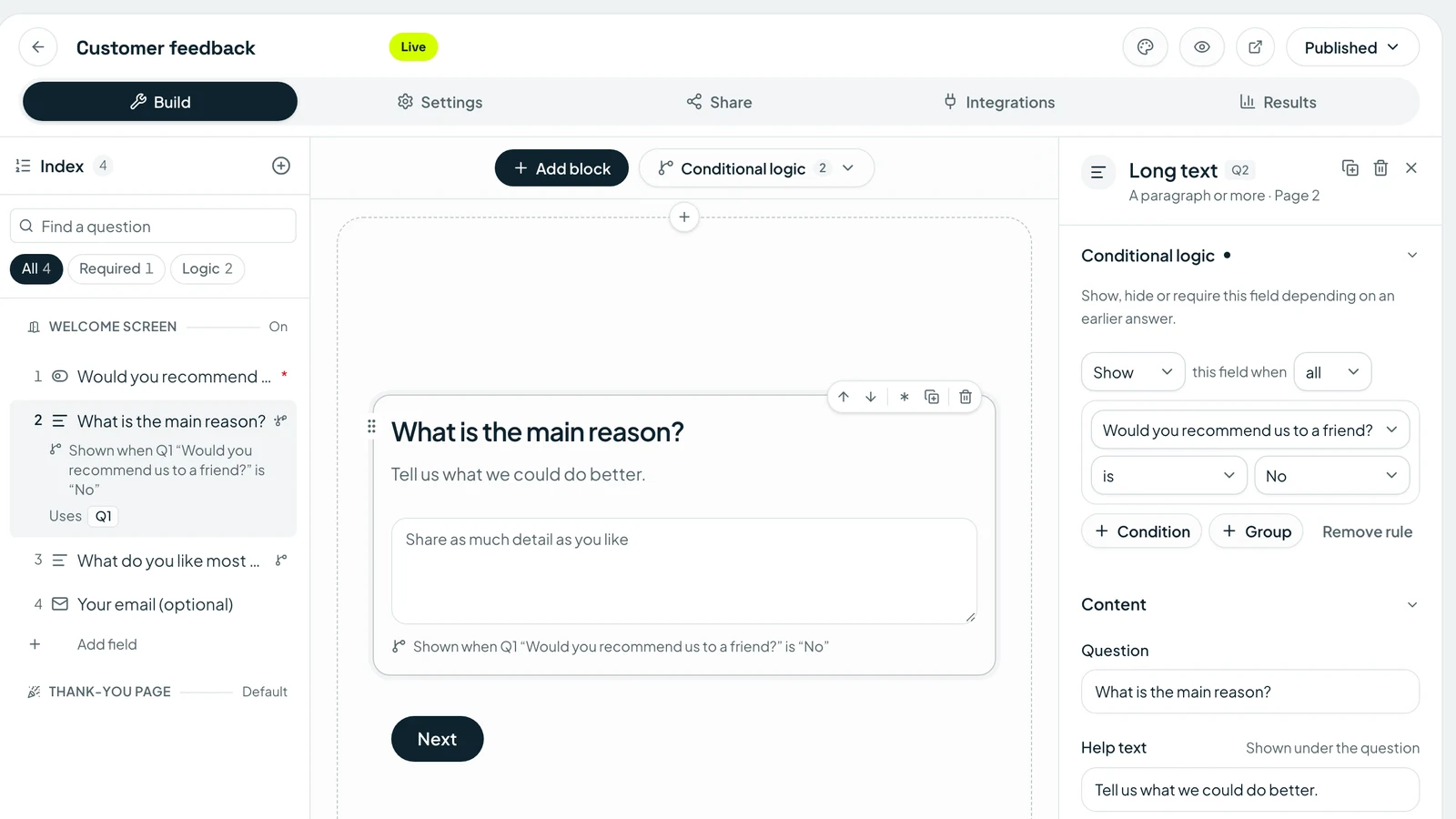
“Would you recommend us?” → if No: “What is the main reason?”
One extra text box turns a number into something you can act on.
6. Use them for skip logic
Place them at the start of a section and send people only to the questions that apply to them.
7. Keep the answer order neutral
Use the same order across the survey (for example, always Yes then No). For opinion pairs like Agree/Disagree, keep the positive and negative answers in a consistent position so nobody is nudged toward one side.
How to create dichotomous questions in Tapzy
Here is how to build a yes/no survey in a few minutes:
Step 1: Create a form
Sign up for Tapzy, go to Forms and click Create form. Start blank or from a template.
Step 2: Add a Yes / No question
Click Add question and pick Yes / No. You can rename both answers, so the same field works for True/False, Agree/Disagree or Like/Dislike.
Step 3: Turn on conditional logic
Send “Yes” answers to a follow-up question and let “No” answers skip ahead, or show a different ending screen for each answer.
Step 4: Share or embed
Copy the link, embed the form on your website or download a QR code for print.
Step 5: Analyze results
Open Answers. Each Yes/No question becomes a chart, so you can see the split at a glance.
Dichotomous questions are short, clear and easy to analyze. They are ideal for screening people, checking facts and powering conditional logic. Their main weakness, the lack of nuance, is easy to fix: write neutral wording, ask one thing at a time and add an open-ended “why” where it matters. Use the 42 examples above as a starting point, then create your first yes/no survey in Tapzy.